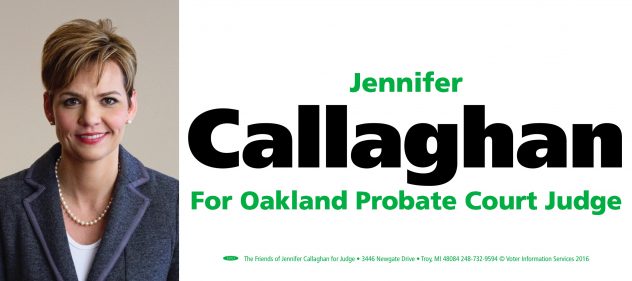
I am pleased to endorse and support Attorney Jennifer Callaghan for Oakland County Probate Judge in the upcoming 2016 county/judicial election which coincides with the 2016 Presidential election. Probate judges play an important role in our community, handling family matters involving children, the elderly, and the disabled. I have had the opportunity to work with and get to know Jennifer in the probate community and the Oakland County Probate Court, where I handle most of my legal work, both private and public. Jennifer is fair and balanced and would serve the Probate Court well with her experience, knowledge, and personal disposition. The Probate Court requires a particular level of discipline across many fields of law, combined with sensitivity and compassion, to which Jennifer excels.
Election Day is November 8, 2016. Thank you for your support.
Roth Law is pleased to announce that Attorney Gregory J. Roth has obtained qualification as both an Oakland County Probate Mediator (effective March 11, 2016) and an Oakland County Civil Mediator (effective March 14, 2016) and has been added to both official lists. Applicants are required to successfully complete a 40-hour civil mediator training course and maintain continuing education in mediation every two years. Mediator approval in Oakland County is by the Application Review Committee.
Gregory J. Roth seeks to develop and concentrate a mediation practice in Probate & Estates Law, a field in which he has practiced as an attorney since 2001. Mr. Roth believes that the probate practice and its litigants will continue to benefit from alternative dispute resolution such as mediation. Mr. Roth also will accept civil mediation assignments within his other practice areas.
Attorney Roth can be reached at (248) 344-4772 or at greg@rothlawpractice.com.
A recent decision by the Michigan Court of Appeals is making waves in the probate and estate planning community. In a self-proclaimed issue of first impression, the Court in In re Estate of (Shelby Jean) Jajuga [1] upheld a sole surviving, disinherited child’s claim to exempt property in her deceased mother’s probate estate.
In a case out of Clare County, Michigan, the sole surviving adult child of the decedent was disinherited in her mother’s will, a will that was reaffirmed in a later will amendment, or codicil. The disinheritance provision in the will was very clear: the disinheritance was not for lack of love but because the children had already received compensation and per the testator it was not in their best interest that they received anything further. Beneficiaries other than the children were instead provided for in the will.
Disinherited Child Claims Exempt Property Allowance Under Statute
Following the mother’s death, the surviving child claimed exempt property allowance under the probate code [2]. The personal representative, who was not the child, denied the allowance. The child then filed a petition with the probate court claiming that the personal representative had refused to pay the preempt property allowance. The child claimed certain property from the estate under the statutory allowance which included a car, a tractor, or in the alternative, $14,000 in cash. The estate argued that the child was not entitled to exempt property under the statute because the child was specifically disinherited in the will.
Court UpholdsExempt Property Allowance Claim
The probate court held that, as an issue of first impression (meaning that the issue had never been addressed by the Michigan appeals courts), the child was entitled to the exempt property requested. The probate court concluded that a testator cannot preclude a child from taking exempt property through a disinheriting provision in a will. The court relied on legal interpretation as well as general public policy, specifically that the exempt property statute is for the protection of souses and children and should be liberally construed, opining that the children’s rights to exempt property are equal to those of a surviving spouse.
The estate appealed. The Michigan Court of Appeals received the case, agreeing that their was an issue of first impression. The Court rejected that the sole focus should not be the testator’s intent as the statute overrides the intent when it comes to statuary protections including exempt property. The Court even addressed the definition of “entitled” (along with other terms found in the statute), finding that the Michigan Legislature’s use of the word establishes a statutory right to a mandatory transfer of exempt property, not merely a priority right. The Court also sided with the probate court that an adult child does not have an inferior right to exempt property when compared to a surviving spouse.
The Court concluded that it would have been “prudent” for the Michigan Legislature to specifically detail the way in which a disinheritance in a will affects a child’s claim to exempt property but furthered that it is not the Court’s role to do so, even though the statute is silent. The Court upheld the probate court’s decision that the child had the right to the exempt property.
Effect on Estate Planning
The Jajuga decision is appears to be a correct interpretation of the exempt property law without further guidance from the Michigan Legislature. Yet it is another example of courts needing to address laws that should have been drafted with more clarity and less room for conflict in the first place. That said, estate planners are best to heed this decision: that a testator cannot completely disinherit children with just a will. For those testators looking to plan around this decision, the use of trusts will be essential, in taking assets out of the probate estate. GJR
Notes
Michigan Court of Appeals Case No. 322522 (Decided October 20, 2015)
On December 4, 2015, Attorney Gregory J. Roth conducted his first private mediation. The mediation resulted in the complete facilitated settlement of a contested trust litigation matter. Attorney Roth appreciated the referral of and opportunity to mediate this case.
For inquiries regarding your potential mediation, please contact our office at (248) 344-4772.
You have spent years building your digital self. So what happens to that digital self when you die?
Your Digital Self
People tend to think of assets as physical possession, such as real estate and cars; or in terms of money, whether it be bank accounts, stock, etc. In the modern information age, however, we have digital footprints whether we intend to or not, and it is increasingly becoming more complicated to avoid.
Legacy Contacts
Who controls your digital self after your death?
Facebook is a good example of the voluntary digital footprint. People identify themselves by or with their Facebook status, posts, and page, and update these things on a regular basis. It is an account like any other account and worth protecting from unauthorized users. However, what happens when you no longer can maintain it due to your own death. At this point nobody is legally authorized to access the account, make changes, or shut down the page.
Facebook now allows users to establish a “legacy contact”. According to Facebook website, a legacy contact is someone you designate to monitor your account if it’s memorialized, which is a special account designation by Facebook that remembers you by preserving your profile instead of deleting it. Facebook has instructions on how to create a legacy contact on its website.
Once your account is memorialized, your legacy contact can then: write a pinned post for your profile (ex: to share a final message on your behalf or provide information about a memorial service, respond to new friend requests (ex: old friends or family members who weren’t yet on Facebook), or update your profile picture and cover photo, or download a copy of what you’ve shared on Facebook.
Per Facebook the legacy contact cannot log into your account, remove or change past posts, photos and other things shared on your Timeline, read messages you’ve sent to other friends, or remove any of your friends.
Assuming that a legacy contact is not established – and many people are not aware of it – there may not be legal recourse to have changes made post mortem, and your Facebook page could continue on indefinitely.
Digital Assets
Facebook is used an example here but is just the tip of the iceberg when it comes to social media or other digital presences. In fact, so much of our daily lives involved so-called “digital assets”, from social media sites, to banking, to shopping, to email. So how do your trusted loved ones access all of these assets after your death? Personal representatives normally are allowed to access online accounts that are tied to non-digital assets, such as bank accounts that represent financial assets. But when accounts are strictly digital, such as Facebook or email, the issue is more complex and the law has not yet caught up.
A Michigan House Bill introduced in 2012 by State Representative Mark Meadows, 2012-HIB-5929, seeks to amend the Estate and Protected Individuals Code (EPIC) [1] by adding a new section giving personal representatives (executors) in Michigan the explicit power to “take control of, conduct, continue, or terminate, and account of the decedent on a social networking, microblogging or short message service, or electronic mail service website.” EPIC specifically grants a set of statutory powers authorized to personal representatives.[2] While all of these powers are in a single section, they wholly or singly do not encompass the powers proposed in the new Bill. This seems to be an easy addition to personal representative powers in Michigan but has been pending for three years now. Michigan is behind some other states who have already enacted such laws. GJR
Roth Law is pleased to announce that Attorney Gregory J. Roth is now offering his services as a probate & estates mediator. Mr. Roth brings his extensive experience in probate & estates law to the mediation table. As an alternative to often protracted and expensive litigation, mediation can benefit parties to probate & estates disputes.
Since 2001, Mr. Roth has has held a variety of roles in the probate & estates petition and litigation process. In the public sphere, he has been appointed by the probate court as guardian ad litem as well as attorney for incapacitated and protected individuals. He has also served as fiduciary for wards in the probate court, with appointments as guardian, conservator, special conservator, and special fiduciary.
Privately, Mr. Roth has represented family members in protective proceedings as well as decedent and trust administration and litigation matters, whether as petitioners, respondents, fiduciaries, or interested persons. Additionally, Mr. Roth has prosecuted and defended creditor claims against probate estates.
Mr. Roth’s breadth of experience with probate & estates administration and litigation lends itself to effective and balanced mediation in all probate court matters and ensures that all parties will be treated fairly. Adding to nearly fifteen years of concentrated probate experience, Mr. Roth has completed the 40-hour civil mediator training course and is seeking qualification on the Oakland County Probate Mediator and Oakland County Civil Mediator lists.
Mediation referrals are being accepted in the following areas:
Guardianship ● Conservatorship
Decedent Estates
Wills ● Trusts ● Powers of Attorney
(medical, financial, “living will”, HIPAA release)
Settlement Protection (for minors)
Wrongful Death Distribution ● Elder Protection
Farmington Hills resident joins 47th District Court, Farmington Voice
The Law Offices of Gregory J. Roth, PC is pleased to announce that local attorney Matthew Friedrich was recently appointed as a 47th Judicial Court (Farmington Hills) magistrate. As one of three magistrates in the court, Magistrate Friedrich will generally preside over small claims matters as well as other matters and will generally assist Judges James B. Brady and Marla E. Parker in their official duties.
Read the Farmington Hills news article, here (click image for link to article).
The Law Offices of Gregory Roth, PC congratulates Magistrate Matthew Friedrich in his recent appointment. GJR
Civil rights attorney Richard Bernstein won one of two vacant seats on the Michigan Supreme Court in Tuesday’s (November 4) election. Bernstein has been legally blind since birth and is well known in the local community for his championing of the disabled as well as being the son of attorney Samuel Bernstein of the Law Offices of Sam Bernstein.
Although the position is technically nonpartisan, Bernstein, a Democratic nominee, will be installed with the other winner of Tuesday’s election, incumbent Justice Brian Zahra, a Republican nominee. Out of a slate of five candidates, Bernstein garnered 29% of the vote to Zahra’s 32%, making them the two highest vote getters, and therefore the election winners.
Bernstein, age 40, has never been a judge before. However, his continual efforts on behalf of persons with disabilities are both noteworthy and commendable.
He successfully represented disabled Detroit residents in 2004 in an action against the City of Detroit to fix wheelchair lifts on buses as required by federal law so all riders could have fair access to public transportation.
He successfully represented the Paralyzed Veterans of America in 2007 in an action against the University of Michigan for failing to include adequate accommodations for spectators with disabilities when planning renovations for the stadium. The suit resulted in increased seating for people with disabilities and their companions and enhanced accessible parking, restrooms and concessions.
He also won a suit filed against Northwest Airlines and the Wayne County Airport Authority on behalf of five disabled passengers to ensure the Airport Authority could make significant modifications to comply with the Americans with Disabilities Act laws.[1]
For his advocacy on behalf of the disabled, the Law Offices of Gregory Roth, PC congratulates Richard Bernstein as our next Michigan Supreme Court Justice. GJR
On Sunday, October 5, 2014, two local chapters of the National Society of the Daughters of the American Revolution held a ceremony to dedicate the grave site of Revolutionary War patriot Hooper Bishop. Local VFW and girl scout members, local dignitaries, and members of the public were in attendance. Hooper is buried in the Novi Cemetery (25445 Novi Road), which contains the graves of many war heroes, including two from the American Revolution.
Bishop was born March 22, 1762 and died on April 3, 1861 at a remarkable old age of 99, especially for the times. His wife, Betsey, predeceased him by nearly 40 years. The couple had four children.[1]
Bishop arrived in Michigan sometime before 1840 to live with his son, Levi, who owned a farm east of Novi. He regaled his grandchildren with stories of the war, from which he kept many relics, including his uniform and musket. At the time of his death, Bishop had a wooden leg and was blind.[2]
Bishop’s service in the war from 1779 to 1781 is recorded as follows:
Private Capt. John Carpenter company; enlisted June 25, 1779; discharged September 25, 1779; service with guards at Springfield enlistment three months.
Private Capt. Caleb Keep’s company, Col. Israel Chapen’s regiment; enlisted October, 1779; discharged November 21, 1779; service 1 month, 11 days; enlisted three months; company raised to reinforce Continental army;
South Brinefield descriptive list of men raised to reinforce Continental army for the term of six months, agreeable to resolve of June 5, 1780; Age, eighteen years; stature, five feet, five inches; complexion dark; residence South Brinefield; arrived in Springfield July 11, 1780; marched to camp July 11, 1780, under command of Captain George Webb.
List of men raised for the six months service and returned by Brig. Gen. Patterson as having passed muster, in a return dated Camp Toloway, October 25, 1780;
Pay roll for six-month men raised by the town of South Brinefield for service in the Continental army during 1780. Marched July, 1870; discharged December, 1780; service five months; discharged at West Point; and
Private Capt. Abel King’s company, Col. Sear’s regiment; enlisted August 20, 1781; discharged November 26, 1781; service three months at Saratoga.[3]GJR
References
History Of Oakland County, Michigan V1: A Narrative Account Of Its Historical Progress, Its People, And Its Principal Interests, Thaddeus DeWitt Seely.Id.
You receive an official-looking and urgent letter in the mail stating that you need to obtain a certified copy of the deed to your house in order to protect yourself and that the company sending the letter can help. This needs to be done immediately, so drop what you are doing and send in your check. Right?
Some Register of Deeds Offices Cry Foul
A number of local register of deeds offices have posted online alerts regarding solicitations of so-called document retrieval service companies, claiming that they are alarming residents into paying excessive fees for something they the residents can do themselves at the local register of deeds office. Some of the alerts include:
A copy of one of the contentious Michigan Document Retrieval Service letters reads:
The Cost of Doing Business
Just because the document retrieval service is charging more money that your local register of deeds charges does not mean that it is a scam. If the company provides the service it claims and it upfront about the costs, the extra money charged equates to the cost of doing business as an understood convenience to the consumer. It is likely inexpensive to go directly to or call your local register of deeds to obtain copies yourself, unless you do not live in the area. For example instead of preparing dinner or walking the dog yourself, you can hire and pay someone else to do it. The consumer weights the options, balancing time vs. money.
But Beware Untruthful Representations
The grey area in terms of scam might be the pressure-filled language and print, or other urgent representations that is often used in these letters to move the consumer to sign up for the service.These companies should be careful not to represent things that are not true; or better yet, to advise the resident of their and option to be able go directly to their local register of deeds office instead.
For example, the Michigan Document Retrieval Service letter clearly uses urgent language such as “Your rights may be in jeopardy…” and “You should obtain one immediately…” It further goes to state that you should have a certified copy of your deed on hand; where, while certified copies are necessary for certain transactions, they are not necessary for research or verification purposes as to title. Also, just having a copy of the deed, while it allows one to verify that information on the deed is correct, does not allow one to verify “free and clear title”, that the property is “free from all liens and encumbrances”, that title is “defendable in court against all legal claims”, or to “verify that property taxes are entered in your name”, as the above document indicates. This is where the potential for misrepresentation, intentional or otherwise, creeps in.
There has been nothing to suggest that these companies do not deliver on the service that they promise. Rather, complaints revolve around the sales tactics but even more so the price. Scam? Probably not. Wise? It’s the buyer’s choice, and buyer should make an educated decision, or beware. GJR



 Gregory J. Roth seeks to develop and concentrate a mediation practice in Probate & Estates Law, a field in which he has practiced as an attorney since 2001. Mr. Roth believes that the probate practice and its litigants will continue to benefit from alternative dispute resolution such as mediation. Mr. Roth also will accept civil mediation assignments within his other practice areas.
 The estate appealed. The Michigan Court of Appeals received the case, agreeing that their was an issue of first impression. The Court rejected that the sole focus should not be the testator’s intent as the statute overrides the intent when it comes to statuary protections including exempt property. The Court even addressed the definition of “entitled” (along with other terms found in the statute), finding that the Michigan Legislature’s use of the word establishes a statutory right to a mandatory transfer of exempt property, not merely a priority right. The Court also sided with the probate court that an adult child does not have an inferior right to exempt property when compared to a surviving spouse.
 On December 4, 2015, Attorney Gregory J. Roth conducted his first private mediation. The mediation resulted in the complete facilitated settlement of a contested trust litigation matter. Attorney Roth appreciated the referral of and opportunity to mediate this case.


 On Sunday, October 5, 2014, two local chapters of the National Society of the Daughters of the American Revolution held a ceremony to dedicate the grave site of Revolutionary War patriot Hooper Bishop. Local VFW and girl scout members, local dignitaries, and members of the public were in attendance. Hooper is buried in the Novi Cemetery (25445 Novi Road), which contains the graves of many war heroes, including two from the American Revolution.